
Questions to Ask Before Starting an Inground Pool Project in the GTA in 2026
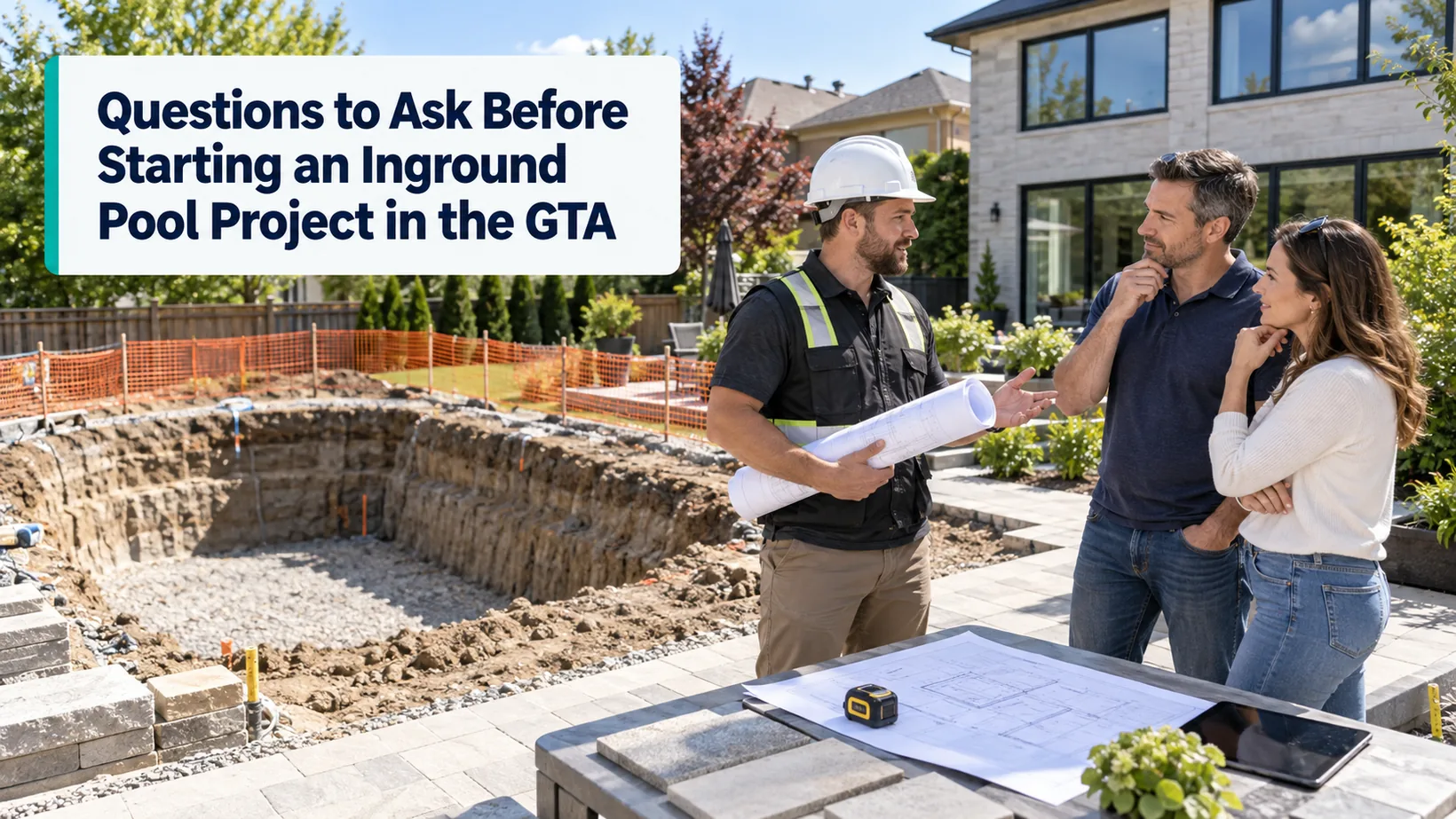
An inground pool consultation should establish whether the project fits the property, what the quoted price actually covers and who owns every approval and construction responsibility. The most useful questions produce documents, names, model numbers and written commitments rather than reassuring verbal answers.
TL;DR
- Begin with intended use, pool system, access, grading and equipment location.
- Ask every builder the same scope, allowance, payment and schedule questions.
- Put approval responsibility, subcontractors, changes and warranties in writing.
- Verify licensed electrical work and request current insurance evidence.
- End each meeting with a list of missing documents and a comparable next step.
Use the following script with every company you interview. Record the answer and the evidence supplied. A blank field is not automatically a rejection, but it is a question to resolve before signing.
What must the pool do for your household?
Start with use rather than shape. Tell the builder whether the priority is family play, lane swimming, entertaining, low-impact exercise, a shallow lounging area or a visual feature. Ask how that priority affects length, depth, entries, benches, circulation and safe-use planning.
Then ask these questions:
- Which pool system fits these uses and why?
- Which feature would you remove first if space or budget is tight?
- What water depth is usable for each activity?
- Where will swimmers enter, rest and leave the pool?
- How will the deck support circulation, furniture and supervision?
The answer should connect a design choice to a stated need. Popularity alone does not establish fit.
Why are you recommending concrete, fiberglass or vinyl?
Ask the builder to compare all realistic systems for the property. Concrete provides extensive design freedom. Fiberglass uses a manufactured shell with predetermined dimensions and features. Vinyl combines an on-site wall and floor structure with a replaceable liner.
The three systems differ in customization, installation characteristics and ownership needs. Ask what you gain and give up with the recommended material.
Request the exact shell model, wall system or concrete finish. Ask whether an alternative changes access, equipment, decking or future surface work.
Mayascapes Pools works with concrete, fiberglass and vinyl inground systems. That breadth supports a property-led comparison, but the recommendation still needs a written explanation.
What on the property could change the design?
Provide the legal survey before relying on a concept drawing. Ask the builder to identify property lines, easements, existing structures, trees, slopes, drainage paths, overhead wires and buried services. The proposed pool, equipment pad, enclosure and access route should all appear on the working plan.
Mississauga’s current pool application process must be completed before construction. The package combines the property survey, an 11 by 17 inch drawing of proposed grades and drainage, and enclosure paperwork. Tree, road-occupancy or conservation approvals may also apply.
Ask:
- Who prepares the scaled site plan and grading information?
- Who confirms zoning and property-specific restrictions?
- Who submits documents, pays fees and responds to revisions?
- Which deposits are paid by the owner?
- What happens if the approved layout must change?
The contract should assign these tasks. A promise that the contractor “handles permits” is not precise enough.
Can excavation and delivery reach the backyard?
Ask the estimator to walk the entire access route. Measure the narrowest opening, note turns and slopes, and identify fences, air-conditioning units, eaves, overhead conductors, septic components and neighbouring property that cannot be used without permission.
For fiberglass, confirm the truck and crane position. For concrete or vinyl, ask about excavator size and material staging. Every system needs an access-restoration plan.
Ask who pays if the planned access proves unavailable. The quote should state whether fence removal, crane service, traffic control, road occupancy, tree protection, plywood protection, soil disposal and restoration are included, excluded or allowances.
Before excavation, confirm the locate process. Ontario One Call’s homeowner excavation guidance explains the public locate request and notes that private infrastructure, such as a line serving a pool heater, may require separate attention. Ask who requests each locate and who reviews the markings before digging.
What exactly is included in the quoted pool?
Have the builder read through the quote by construction stage. A complete discussion should cover design, excavation, soil handling, structure or shell, plumbing, equipment, electrical work, gas work, coping, deck, drainage, enclosure, startup, cleanup and restoration.
For each line, mark one of four states: included, excluded, allowance or undecided. Ask for quantities and exact products where they control value. “Equipment package” should become named pump, filter, heater, sanitation, lighting and automation models.
Ask these scope questions:
- How much deck area and which base preparation are included?
- Is difficult soil or groundwater treated as an allowance?
- Are utility connections included to the final equipment location?
- Who supplies and installs the fence or enclosure changes?
- Is final grading, sod and planting included?
- Which owner decisions have selection deadlines?
Ask the builder to issue a revised written quote after the meeting. Handwritten notes on your copy do not amend the contractor’s offer.
Which allowances could change the final price?
An allowance is a placeholder for a product or task that is not fully selected or measured. Ask what quantity and unit price support it, what alternatives fit within it and how any difference will be calculated.
Pay particular attention to excavation, soil export, rock, dewatering, crane service, electrical runs, gas runs, retaining work, deck materials and landscaping. These categories can differ sharply among properties.
Ontario’s home renovation consumer guidance advises collecting three written bids. Agreements above $50 must be documented, and a contract that incorporates an estimate generally limits the final amount to 110 percent unless the parties approve a different price or added work.
Ask how the company documents a changed condition. Before extras begin, both parties should sign a record stating the revised task, price, tax and timing.
Who will manage the project and the trades?
The salesperson may not manage construction. Ask for the role and contact details of the person who will issue updates, coordinate trades, approve site decisions and handle deficiencies.
Request a list of expected subcontracted work. Electrical, gas, concrete, fencing and landscaping responsibilities should be visible in the contract, including who pays each trade and who corrects damage between scopes.
For electrical work, verify the contracting business rather than relying on an individual electrician’s credentials. Ontario’s Electrical Safety Authority says only a Licensed Electrical Contractor can be hired to perform electrical work in a home. Its licensed-contractor guidance provides a public verification route.
Ask for the electrical contractor’s ECRA/ESA licence number and identify who obtains the required notification. Also request current commercial liability insurance evidence for the general contractor and clarify how subcontractor coverage is checked.
How is the schedule built and updated?
Ask for phases, dependencies and decision deadlines rather than one completion date. Approval, product availability, excavation, inspections, weather, site conditions and trade sequencing can all affect progress.
Ask what must happen before excavation, which products must arrive first, what weather conditions control work, how often the schedule is updated and how owner changes affect timing.
Tie payments to defined, observable milestones. Avoid a schedule that requires most of the contract value before the pool is operational, inspected and supported by closeout documents.
How will changes and site surprises be handled?
Ask for examples of conditions that cannot be confirmed before excavation. The contract should explain notice, documentation and approval, not transfer every unknown to the homeowner without a method.
A proper change record includes the reason, revised scope, added or deducted price, tax, revised schedule and signatures. Photographs can document hidden conditions, but they do not replace an agreed price.
Also ask who can authorize changes. A casual site conversation should not create an invoice.
What do the warranties actually cover?
Separate the manufacturer’s product warranty from the builder’s workmanship warranty. A fiberglass shell, vinyl liner, pump, heater, light and automation system may each have different providers, terms, exclusions and claim routes.
Ask for the actual documents before signing. Record the coverage period, original-purchaser condition, registration deadline, required maintenance, labour coverage, prorating, transfer rules and exclusions. Ask who diagnoses a problem and who pays for removal, shipping, water, deck access or reinstalling a covered part.
The workmanship warranty should name covered tasks and the service process. Ask whether seasonal startup, water care or freeze damage can affect coverage and what records the owner must retain.
What should we receive at handoff?
Define completion before the project begins. A useful handoff package includes approved inspection records, model and serial numbers, warranty documents, product registrations, equipment manuals, startup settings, care instructions and service contacts.
Ask who demonstrates the equipment and winterization controls. Record deficiencies with dates and responsibility, and distinguish usable, substantially complete and fully closed out.
Use this meeting record for every builder
End the consultation by writing five lists: confirmed decisions, included scope, exclusions, allowances and missing evidence. Ask the builder to correct misunderstandings in the next written proposal.
Then score only what was demonstrated:
| Meeting field | Record before shortlisting |
|---|---|
| Design fit | Recommended system and property-specific reason |
| Site fit | Access, grading, utilities and equipment location |
| Approval plan | Named preparer, submitter and owner costs |
| Quote clarity | Inclusions, exclusions, quantities and allowances |
| Delivery plan | Manager, trades, phases and update frequency |
| Risk control | Change-order and hidden-condition process |
| Ownership support | Warranty documents and handoff package |
Do not total the scores until every builder has answered the same questions. The purpose is to expose unresolved differences, not to make a complex decision look mathematically certain.
Your final questions before signing
A productive pool consultation ends with a property-specific design, an itemized scope and named responsibility for approvals, trades, changes and aftercare. Mississauga’s current process makes the survey, grading plan and enclosure approval central, while Ontario consumer guidance makes the written estimate and contract essential.
Mayascapes can be considered when comparing concrete, fiberglass and vinyl within an integrated pool-and-landscape plan. Apply the same meeting script to every finalist, obtain the outstanding documents and sign only when the written proposal matches the answers you were given.
Questions homeowners often miss in the meeting
Should I ask for references before or after the quote?
Ask after the builder understands the project. Request recent work using your proposed material and comparable access, grade or landscape scope, then ask about changes, communication and service.
Who should pay municipal fees and refundable deposits?
Either party can administer agreed payments, but the quote should identify each fee or deposit, who pays it and who receives any refund. Confirm current amounts directly with the City.
Is a long warranty automatically better?
No. Compare coverage, exclusions, labour, prorating, transfer rules and the claim process. A shorter clear warranty may be more useful than a long headline term with narrow coverage.
Can the consultation answer the final project cost?
Usually not. Survey review, selections, access, site conditions and trade scopes may still require confirmation. The goal is a traceable written price with bounded allowances, not false precision.