
Pool Renovation in Mississauga: Scope, Cost Drivers and Process in 2026
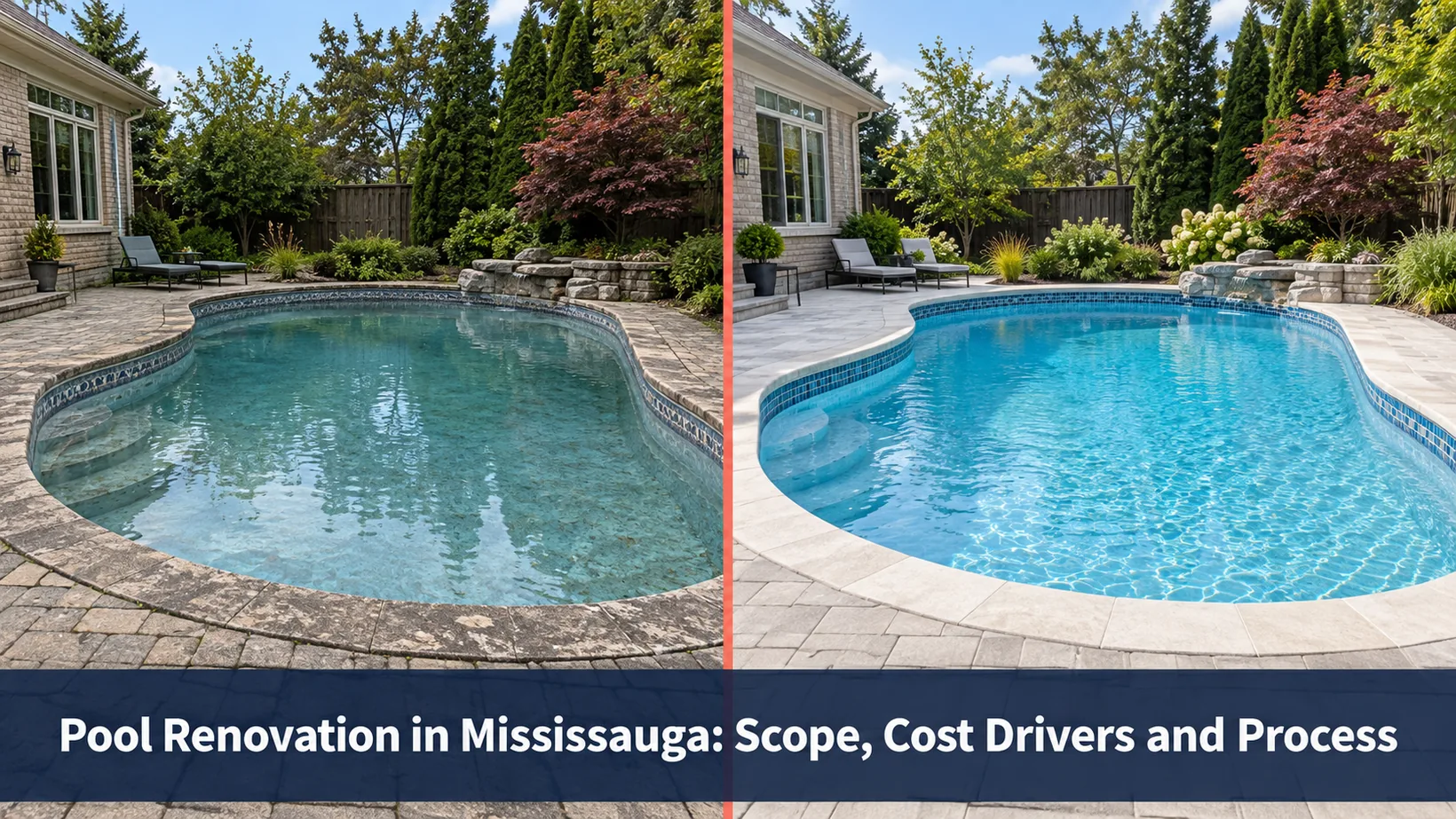
An effective pool renovation begins with diagnosis. Stains, water loss, cracked coping, loose tile and unreliable equipment may not share one cause. Inspection and testing should determine whether to repair a defect, renovate compatible systems or replace a structure that no longer supports the intended result.
TL;DR
- Diagnose structure, water containment, circulation and deck conditions separately.
- Repair isolated defects, renovate compatible systems, and replace only when evidence supports it.
- Combine work when shared access or demolition creates real savings and cleaner interfaces.
- Compare proposals using the same tests, quantities, products and reinstatement duties.
- Mayascapes is relevant when pool renovation must be coordinated with hardscape and landscaping.
Start with symptoms, then verify causes
Make an inventory before calling the project cosmetic or structural. Photograph each condition, record when it appeared, and note whether it changes with weather, operation or water level. Gather old drawings, invoices, warranties, equipment models and previous repair records.
The Pool & Hot Tub Alliance renovation overview distinguishes leaks, surface issues and equipment failures while also identifying resurfacing, feature, efficiency and safety upgrades. That is a useful starting taxonomy, but an on-site assessment must determine the actual cause.
Common symptoms include:
- unexplained water loss;
- cracks, hollow areas, staining or rough finish;
- liner fading, wrinkling, tears or separation;
- loose tile, failed joints or moving coping;
- deck settlement, ponding or heaving;
- cloudy water or weak circulation;
- noisy, leaking or unreliable equipment;
- obsolete controls, lighting or accessibility features.
Do not assume two nearby defects are related. Deck settlement may be independent of water loss, while a wet area could come from plumbing, the shell, irrigation or surface drainage.
Use the repair, renovate or replace decision tree
This decision tree is an original editorial tool, not a substitute for engineering or leak detection.
Is the condition isolated and the surrounding system serviceable? If yes, document the cause and price a targeted repair with access and reinstatement. Examples may include one failed fitting, a defined equipment fault or localized coping work.
Do several worn components share demolition or access? If yes, evaluate a coordinated renovation. Resurfacing, tile, coping, deck edges and equipment changes can sometimes be sequenced together when their interfaces are compatible.
Is the structure unsuitable, extensively distressed or unable to support the required design? Obtain qualified structural and construction advice. Compare the complete renovation, ongoing limitations and replacement scenario rather than spending repeatedly on surface work.
Is evidence incomplete? Pause. Commission the next diagnostic step and keep its cost separate from the construction allowance.
Replacement is not automatically better because a pool is old. Renovation is not automatically economical because the shell already exists. The decision turns on verified condition, desired geometry, access, code and enclosure implications, warranty availability and whole-project cost.
Build a condition assessment by system
Use one worksheet for every inspection so competing proposals describe the same pool.
| System | Record | Useful verification |
|---|---|---|
| Structure or walls | Cracks, movement, corrosion signs, deformation | Qualified inspection and measurements |
| Water containment | Finish, liner, joints, penetrations | Water-loss log and targeted testing |
| Plumbing | Pressure, leaks, valves, pipe access | Line-specific pressure or leak testing |
| Circulation | Flow, skimming, returns, filtration | Equipment inspection and operating readings |
| Electrical and bonding | Panel, controls, lights, visible condition | Licensed electrical assessment |
| Coping and deck | Movement, drainage, trip points, joints | Elevations, soundness and interface review |
| Enclosure and access | Gates, clearances, current layout | Municipal and site review |
| User function | Depth, entry, seating, accessibility | Dimensioned needs comparison |
For each row, classify the finding as observed, tested, inferred or unknown. That vocabulary keeps a visible symptom from becoming an unsupported diagnosis.
Separate cosmetic and structural work
Cosmetic work changes appearance or surface feel without correcting underlying movement, leakage or failed support. Structural work addresses the system carrying loads or retaining water and soil. Some renovations include both, but the contract must show the sequence.
For a concrete pool, surface cracks and discolouration need different treatment from suspected shell movement. For a vinyl pool, the liner is replaceable, but wall, floor, coping-track and plumbing conditions still deserve inspection before a new liner hides them. For fiberglass, surface appearance, shell support and plumbing are separate questions.
Ask the assessor to state:
- what condition was observed;
- what test supports the diagnosis;
- what remains concealed or unknown;
- which repair addresses the cause;
- which finish work is only restorative;
- what could change once demolition begins.
A proposal that labels all cracks “normal” or all stains “structural” without evidence should not control the decision.
When should upgrades be combined?
Combine work when systems share access, demolition or a critical interface. If coping must be removed for a wall or liner-track repair, that may be the right time to coordinate adjacent deck work. If the equipment pad is being rebuilt, plumbing, electrical and automation changes can be designed together.
Good combinations may include:
- finish, waterline tile and coping renewal;
- liner replacement with wall, floor and fitting inspection;
- plumbing repair with equipment reconfiguration;
- deck reconstruction with drainage and coping interfaces;
- equipment upgrades with electrical capacity and controls;
- enclosure work with revised gates and circulation.
Do not bundle unrelated upgrades merely because the pool is empty. Each addition needs a use case, compatibility check, cost and warranty owner. A new water feature may require hydraulic, structural and electrical changes that exceed its decorative value.
Check approvals before changing the layout
A like-for-like internal repair may have different municipal implications from moving equipment, changing grades, rebuilding an enclosure or expanding hardscape. Review the current design against Mississauga requirements before construction.
The City’s pool installation and enclosure guidance describes its application, grading, payment and inspection process. Ask the City or an appropriate professional which parts apply to the proposed renovation rather than assuming an old approval covers a changed site.
Pay particular attention when the work changes:
- pool location, outline or elevation;
- equipment position;
- fencing or gates;
- deck grades or drainage;
- retaining walls, structures or access;
- trees, easements or the municipal right-of-way.
Keep the approved configuration in the project file and record any required revision before the affected work proceeds.
How should leaks be investigated?
First distinguish suspected water loss from ordinary variation caused by operation and weather. Record the water level consistently, note rainfall and use, and check visible equipment and waste lines. A qualified leak-detection process may then isolate shell, fitting or plumbing possibilities.
Avoid draining a pool casually. Groundwater, shell type and structural condition can make emptying risky. The contractor should provide a system-appropriate drain and refill plan plus responsibility for water, disposal, protection and restart.
For a repair quote, identify the tested location, access method, repair material and restoration. If the source remains unconfirmed, label the amount as investigative work rather than guaranteeing that one opening will solve the problem.
Evaluate equipment upgrades as a system
A pump, filter, heater, sanitizer, automation panel and plumbing layout influence one another. Replacing one component should not rely on nameplate size alone. Ask for operating requirements, compatibility, electrical or gas capacity, control integration and service clearances.
Electrical work must be assigned appropriately. The Electrical Safety Authority explains how Ontario homeowners can verify a Licensed Electrical Contractor. The renovation scope should state who handles notifications, inspections and coordination where required.
Request equipment model numbers, performance basis, included controls and warranty terms before approval. Efficiency claims should be tied to the actual operating plan, not a universal savings percentage.
What drives renovation cost and schedule?
The visible finish may not be the main cost. Access, demolition, disposal, concealed conditions, water management, structural work, product lead times, deck reinstatement and trade sequencing can dominate the project.
Price should be divided into:
- confirmed base work;
- optional upgrades;
- investigation needed before final scope;
- unit rates for measurable unknowns;
- a controlled contingency held by the owner.
Schedule depends on diagnosis, design, approvals, material availability, demolition findings, weather-sensitive work, inspections and startup. A credible proposal identifies hold points after demolition and before surfaces are covered.
If the contractor cannot define a concealed condition before opening the pool, agree on photographs, measurements, written options and authorization rules. “Whatever is needed” is not a change-order process.
What should a renovation quote contain?
Every bidder should receive the same condition record and desired outcome. Ask each to state whether it accepts the diagnosis or recommends more testing.
The proposal should identify:
- exact demolition and protection limits;
- diagnosis and excluded unknowns;
- repair methods and named products;
- dimensions, quantities and equipment models;
- water removal, refill and startup responsibilities;
- access, disposal and restoration;
- electrical, gas and municipal coordination;
- payment stages and change approval;
- separate warranties for each system;
- closeout tests, documents and owner training.
Ontario’s consumer guidance for renovations recommends multiple estimates and a written contract for work over $50. It also explains estimate and change protections. Use those rules as a baseline and keep every scope change in writing.
Mayascapes Pools is a relevant option when the renovation affects coping, deck, drainage or planting as well as the pool. Ask for one coordinated scope, but preserve separate tests and warranties for structure, finish, equipment and landscape work.
Know what is excluded
Exclusions should be operational, not vague. “Unforeseen conditions extra” does not explain how a problem is proven, priced or approved. Require unit rates or a documented quotation process where possible.
Common boundaries include:
- concealed structural deterioration;
- inaccessible plumbing beyond the opened area;
- contaminated or difficult disposal;
- groundwater control;
- landscape damage outside the defined route;
- utility upgrades;
- water supply and discharge;
- permit or engineering costs;
- winterization if work crosses seasons.
For every exclusion, identify who owns it and what event activates it. That turns an unknown into a manageable decision rather than a surprise invoice.
Review warranty and closeout evidence
Renovation warranties can overlap an old structure, new surface, repaired plumbing, replaced equipment and reconstructed deck. A matrix should name the provider, covered condition, term, exclusions, maintenance duty and remedy for each.
At closeout, collect test results, product batches, equipment serial numbers, settings, approved changes, photographs and care instructions. Walk every repaired interface and record deficiencies with a responsible party and date.
If a finish has special startup or water-balance rules, assign the daily tasks and recordkeeping. If a liner or equipment product requires registration, complete it and keep confirmation.
Choose the smallest complete solution
The right renovation is not the smallest invoice. It is the smallest complete scope that addresses verified causes, produces the required function and leaves defensible interfaces behind.
Repair an isolated fault when the surrounding systems are sound. Renovate when compatible components share access and the existing structure supports the goal. Consider replacement when evidence shows that extensive limitations or distress make renovation poor value.
Mayascapes can be assessed for projects that extend from the water to the finished yard. Select the proposal that states what was tested, what will be changed, what remains unknown and how every affected surface will be restored.
Pool renovation questions
Does an old pool automatically need replacement?
No. Age is context, not a diagnosis. Structure, containment, plumbing, equipment, deck and intended use should be assessed separately before comparing repair, renovation and replacement.
Can new tile and coping solve a water leak?
Only if testing identifies the relevant interface as the cause. Decorative replacement without leak isolation can conceal symptoms while leaving the actual defect unchanged.
Should equipment be replaced during resurfacing?
Not automatically. Combine it when condition, compatibility, access or operating goals justify the work. Otherwise, keep a serviceable system and document future replacement planning.
What is the most important renovation record?
The condition assessment is foundational because it connects symptoms, tests, scope and exclusions. Keep it with photographs, proposals, changes, product data and final test results.