
Fiberglass Pool Installation in Mississauga in 2026
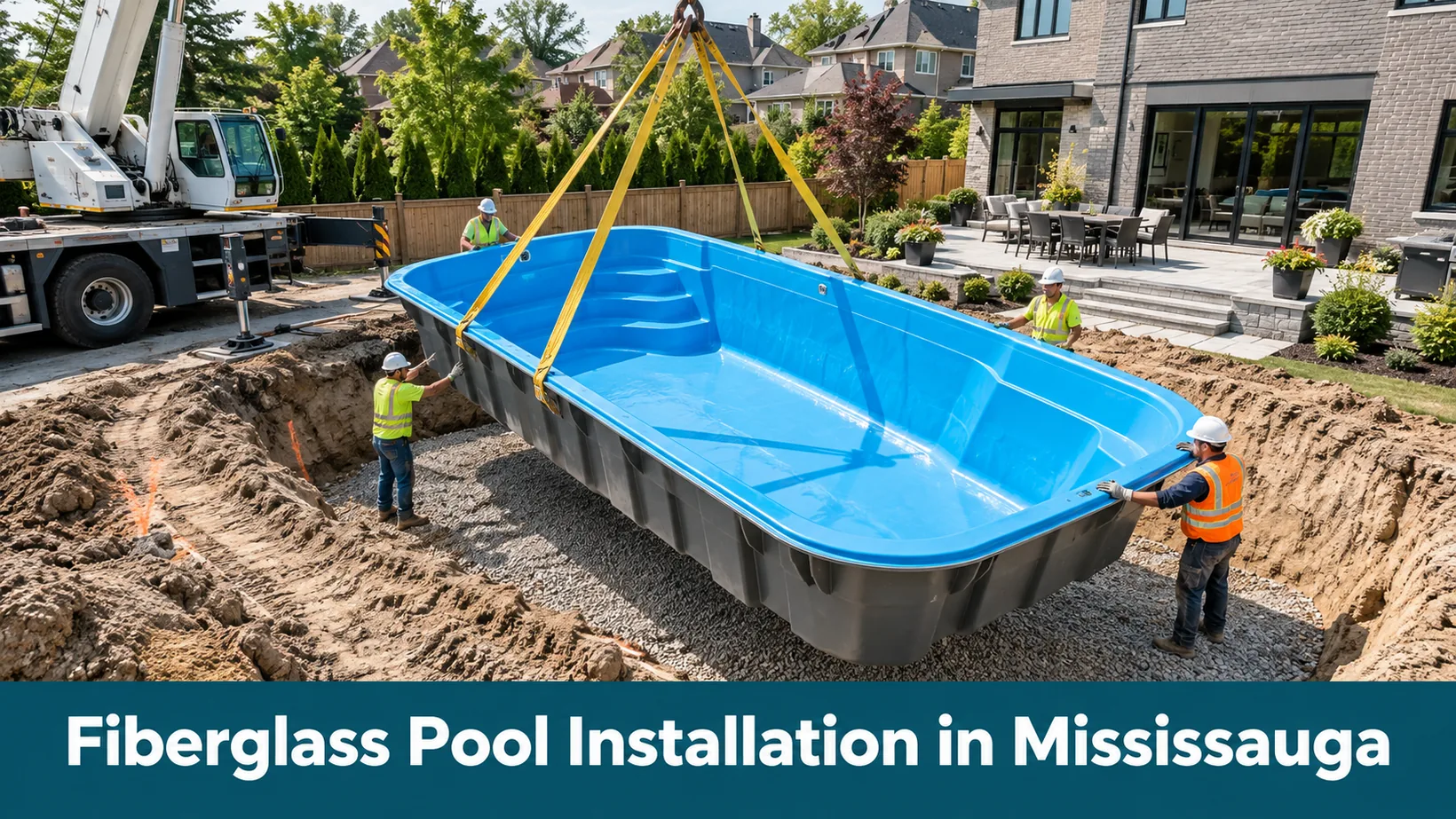
A fiberglass pool can be a strong fit when an available shell matches the household’s needs and the property provides a workable delivery route. The decision must begin with model dimensions, grade, access and approvals because the pool arrives as a manufactured structure rather than being shaped entirely on site.
TL;DR
- Select an exact shell only after checking use, dimensions, depth and setbacks.
- Confirm the truck, crane, overhead and staging route before relying on a price.
- Compare excavation, base, backfill, plumbing, decking and restoration line by line.
- Separate the manufacturer’s shell warranty from the installer’s workmanship terms.
- Mayascapes suits projects that need pool installation coordinated with the surrounding landscape.
Fiberglass is not automatically the fastest or easiest choice for every yard. A suitable installation depends on approved plans, product availability, excavation conditions, delivery access, correct support and coordinated deck and drainage work.
Who is a fiberglass pool best suited to?
Start with the catalogue constraint. A fiberglass shell comes from a mould, so its length, width, depth profile, steps, benches and ledges are established by the selected model. That can simplify decisions, but it offers less geometric freedom than a custom concrete pool.
Fiberglass deserves a place on the shortlist when:
- an available model fits the usable yard and swimming priorities;
- a truck and crane can reach a safe lifting position;
- the household values a smooth manufactured interior;
- a predictable set of shell features is preferable to custom geometry;
- the deck and landscape can be designed around the model.
The Pool & Hot Tub Alliance material guide identifies fiberglass as a smooth, manufactured option with comparatively quick installation characteristics. Treat that as a general distinction, not a project schedule promise.
Choose another system when no shell provides the required dimensions, depth transition or custom feature. Also reconsider fiberglass when delivery would depend on unconfirmed neighbouring access, unsafe overhead clearance or a crane plan that has not been priced.
Select the shell by usable space, not catalogue size alone
The pool model’s outside dimensions are only one part of the fit. The approved plan must also accommodate setbacks, equipment, enclosure, deck circulation, drainage and any easements or protected features.
List the activities first. Lap swimming requires usable length. Young-family use may favour broad steps and visible shallow space. Lounging may favour a tanning ledge, while deeper recreation needs an appropriate depth profile and safe-use design.
For each candidate model, record:
| Decision field | What to confirm |
|---|---|
| Water use | Swimming, play, exercise, lounging or entertaining |
| Exact model | Manufacturer, model name and current drawing |
| Dimensions | Exterior shell and usable interior dimensions |
| Depth | Shallow and deep points plus transition |
| Built-in features | Steps, benches, ledges and spa relationship |
| Site fit | Setbacks, deck, enclosure and equipment space |
| Delivery fit | Truck position, crane radius and overhead clearance |
Do not approve a shell from a rendering alone. Review the current technical drawing and, where possible, experience the step, bench and depth layout at a display or completed pool.
Check Mississauga zoning and approval requirements early
The City of Mississauga requires an accepted application and applicable payments before installation. Its current pool process asks for the legal survey, a large-format drawing that documents elevations and drainage changes, and enclosure paperwork.
The City may also require tree, road-occupancy or conservation-related permission depending on the property and construction route. It schedules a pre-construction meeting after plan acceptance and requires a final enclosure inspection before the pool is filled.
Ask the installer to identify:
- who prepares the site plan and grading information;
- who checks property-specific zoning restrictions;
- who submits and revises the application;
- which fees and refundable deposits the owner pays;
- who books the enclosure and final grading inspections.
The shell order should not outrun the site review. A model is not a final fit until the property plan and delivery method work together.
Use an access and crane decision tree
Begin at the street and follow the entire route to the excavation. Record truck access, road restrictions, possible crane locations, overhead wires, mature trees, rooflines, fences and neighbouring property. Measure the narrowest route and photograph each constraint.
Use these decisions:
Can the shell travel directly into the yard? If yes, confirm equipment width, turning space and surface protection. If no, continue to the crane assessment.
Can a crane stand on the property? Confirm ground bearing, outriggers, lift radius and overhead clearance with the qualified lifting provider. Do not assume a driveway is suitable.
Must the crane occupy a road or public area? Ask whether a road-occupancy permit, traffic control or special scheduling is required and who pays.
Does the lift cross another property? Obtain written permission and an insured, professionally planned route. If access is uncertain, do not treat it as available.
Before digging, map utility infrastructure. Ontario One Call’s residential information describes the public request, while noting that some owner-operated services fall outside it. Assign responsibility for that request and for any independent private locate.
What happens during fiberglass pool installation?
The sequence varies by site and manufacturer, but a complete proposal should account for these stages:
- Final survey review, approved layout and shell confirmation.
- Access preparation, protection and required removals.
- Layout, excavation and management of excavated material.
- Base preparation to the specified elevation and support condition.
- Shell delivery, lifting, placement and level checks.
- Plumbing connections, backfill and controlled water filling.
- Equipment, electrical and heating work.
- Coping, deck, drainage, enclosure and landscape restoration.
- Inspections, startup, training and warranty handoff.
Ask which manufacturer instructions control the base, bedding, backfill, groundwater management and fill sequence. The installer should not replace a model-specific method with a generic description.
Weather and ground conditions can interrupt the sequence. The contract should explain how an open excavation, groundwater or delayed shell delivery will be managed without promising that every site follows the same number of days.
What should a fiberglass quote include?
Request an itemized scope rather than one shell-and-installation total. The quote should name the manufacturer and model, colour or finish, included fittings, circulation equipment, lights, heating, sanitation, controls and warranty documents.
It should also state:
- site-plan and approval responsibilities;
- access preparation and restoration;
- crane, lifting and traffic-control assumptions;
- excavation, soil export, disposal and difficult-ground rules;
- base and backfill specifications;
- tested circulation plumbing and equipment-base construction;
- electrical and gas responsibilities;
- coping, deck quantity, drainage and expansion detail;
- fencing, cleanup, sod and planting restoration;
- payment stages, change orders and closeout.
Code each line as covered, owner-supplied, a provisional sum or unanswered. Add every required owner-paid task before comparing another material proposal.
Which costs are most sensitive to the property?
Shell model and options matter, but the lot can create larger differences between apparently similar projects. Crane logistics, excavated-material disposal, difficult geology, water control, structural landscaping, distant utility connections, deck area and restoration are all property-specific.
Request separate pricing for optional water features, covers and upgraded controls so the base comparison remains clear.
Record shell availability separately because a current production or delivery window can change without altering site feasibility.
Ask for the assumption behind each allowance. Crane pricing should identify the lifting position and conditions. Soil pricing needs a quantity or rate. Deck pricing needs dimensions, selected product and base construction.
Avoid using a broad online fiberglass pool price as a budget promise. It may omit local approvals, access, equipment, utilities and the finished backyard.
Read the warranty as two separate commitments
The shell manufacturer and installer answer different questions. Product terms may cover defined structural or surface defects, while the contractor’s separate promise should identify the installation tasks it accepts.
Ask for the exact current document for the quoted shell. For example, Latham’s 2026 fiberglass limited warranty limits coverage to defined conditions and contains owner, installation and maintenance requirements. Its headline term is not a substitute for reading the exclusions.
Record:
- original-purchaser and residential-use conditions;
- what qualifies as structural or surface failure;
- required installer qualifications or standards;
- water-level and water-chemistry duties;
- registration and recordkeeping requirements;
- labour, transport, access and reinstatement exclusions;
- who handles the first claim contact.
Ask the installer to provide its own written workmanship terms. A manufacturer does not automatically assume responsibility for excavation, support, plumbing, deck or drainage work.
Plan the deck and landscape with the shell
The finished pool is a relationship among water, coping, deck, grade and planting. Deck elevations must shed water appropriately while preserving the property’s approved drainage. Equipment needs service access, airflow and a location that meets applicable rules.
Mayascapes Pools is a practical candidate when a Mississauga homeowner wants the fiberglass installation coordinated with coping, interlocking or other deck work, grading and landscape construction. The advantage is potential scope continuity, not permission to leave quantities vague.
Ask Mayascapes to show the exact shell, crane route, deck area, drainage approach and landscape restoration in one marked plan. Separate product, installation and hardscape warranties even when one contractor coordinates the work.
What should happen at handoff?
At closeout, verify the enclosure certificate plus outstanding City reviews of finished grades and municipal property. Walk the coping, deck, equipment area, drainage and restored route. Record deficiencies with owners and dates.
The handoff package should include shell identification, equipment models and serial numbers, warranty documents, registrations, approved records, startup settings, operating instructions and service contacts. Ask for demonstrations of circulation, heating, sanitation, lighting and automation.
Keep water-test and maintenance records when the warranty requires them. Confirm winterization responsibility and the conditions for any first-season service.
Is fiberglass right for your Mississauga property?
Fiberglass is a strong option when a current shell model fits the intended use, the approved site plan has enough space and the delivery route is professionally confirmed. Mississauga’s application and inspection process, the crane plan and the model-specific installation requirements should all be resolved before excavation.
Mayascapes can coordinate the pool with deck, drainage and landscape work, but the quote should still identify every quantity, allowance and warranty owner. Choose fiberglass only after the exact shell, access plan and complete-backyard scope pass the same written test.
Fiberglass planning questions
Does a fiberglass pool always require a crane?
Not always, but many installations use one because the shell arrives in one piece. The delivery and lifting method depends on the model, property access and safe equipment positioning.
Can the shell be customized after it is ordered?
The moulded geometry cannot be reshaped on site. Options such as colour, fittings and compatible features depend on the manufacturer and model, so confirm them before ordering.
Who handles a shell warranty claim?
The warranty document controls the process. Ask whether the original dealer starts the claim, what records are required and which labour or access costs remain outside manufacturer coverage.
When can the pool be filled?
Follow the installer’s controlled placement and fill sequence, then the City’s enclosure requirements. Mississauga requires the final enclosure inspection before the first full use and filling step described by its process.