
Fiberglass vs Vinyl vs Concrete Pools for Ontario Backyards in 2026
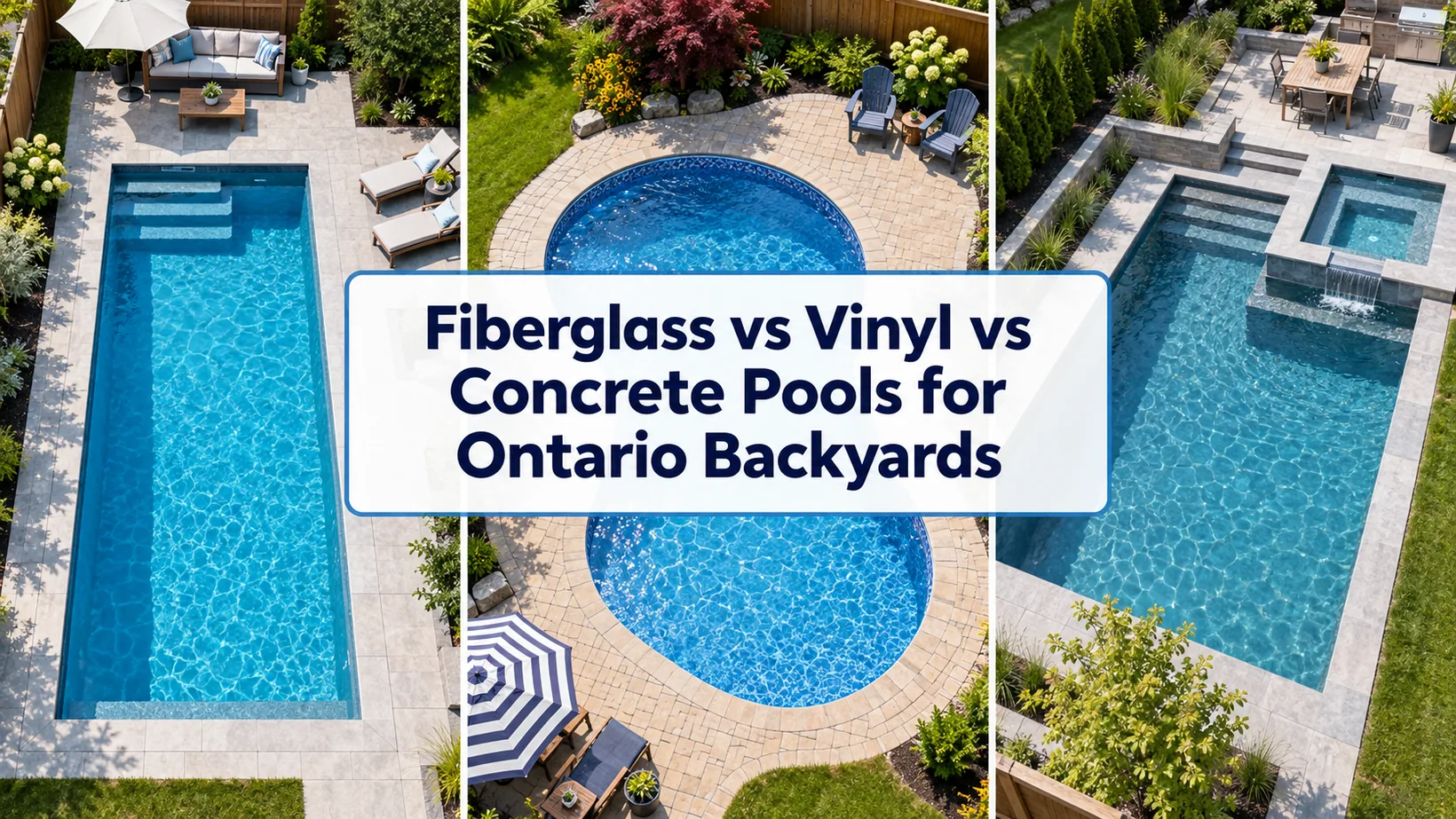
Choosing among fiberglass, vinyl and concrete is not a contest with one universal winner. It is a decision about which construction system best fits the property, design brief, schedule, maintenance tolerance and long-term ownership plan.
TL;DR
- Fiberglass usually offers the shortest on-site construction period, but the selected shell must reach the yard.
- Vinyl offers flexible shapes and a replaceable interior at a generally accessible initial price point.
- Concrete provides the greatest freedom in geometry, depth and integrated features, with a longer build and more finish care.
- Access, grading and the finished landscape can change the practical choice before appearance does.
- Score all three systems against the same priorities instead of choosing from a generic ranking.
Fiberglass, vinyl and concrete at a glance
The Pool & Hot Tub Alliance comparison of pool types characterizes concrete as highly customizable, fiberglass as smooth and relatively quick to install, and vinyl as adaptable in shape with a replaceable liner. Those broad distinctions are useful, but a homeowner still needs to translate them into property-level consequences.
| Decision factor | Fiberglass | Vinyl liner | Concrete |
|---|---|---|---|
| Form | Factory-made shell | Site-built structure with liner | Site-built reinforced shell |
| Design freedom | Limited to available moulds | Broad range of planned shapes | Highest geometric and feature flexibility |
| On-site schedule | Usually shortest after approvals and site readiness | Usually moderate | Usually longest and most stage-dependent |
| Access issue | Complete shell needs a delivery and lift route | Materials can enter in smaller components | Materials and equipment still need construction access |
| Interior | Integrated factory surface | Replaceable liner | Selected plaster or other compatible finish |
| Major renewal | Product-specific surface or repair work | Eventual liner replacement | Periodic finish renewal |
| Best starting point | A proven shell suits the yard and brief | Value, shape flexibility and replaceability matter | Custom geometry or integrated features drive the project |
These are directional differences, not warranties. Exact products, site conditions, builder methods and water care affect the result.
Which pool type is fastest to install?
Fiberglass generally has the shortest on-site construction phase because the shell arrives formed. Excavation, base preparation, lifting, levelling, plumbing, backfilling, decking and commissioning still need coordination. A fast shell placement is not the same as a finished backyard.
Vinyl construction is completed on site, but the structural system and liner installation can usually proceed with fewer finish stages than concrete. Concrete requires forming, steel, plumbing, shell placement, curing, coping, interior finishing and a controlled startup. Each dependency adds calendar exposure.
Approvals, utility checks, procurement, weather, access and landscape restoration sit outside simple installation claims. Compare schedules from the same starting point and to the same finish line: approved design to usable, inspected yard.
Which material offers the most design freedom?
Concrete is the strongest option when the pool must follow unusual geometry, include a highly specific depth profile, integrate a spa or ledge, or relate precisely to complex architecture. That freedom creates more decisions and makes documentation important.
Vinyl supports many standard and custom configurations. It can serve families that want shape choice without a site-applied concrete interior. Steps, benches and transitions should be specified clearly because the liner must fit the completed structure.
Fiberglass asks the homeowner to select from a manufacturer’s mould library. Many shells include benches, ledges and contemporary forms, but their dimensions cannot be stretched to suit a difficult plan.
The advantage is that the form and surface are established before arrival. The constraint is that the available model must work as designed.
How backyard access changes the answer
Access is often the decisive difference. A fiberglass shell needs a viable route from delivery vehicle to excavation, commonly involving a crane. Overhead wires, mature trees, neighbouring property, road occupancy and the lift radius can affect feasibility and cost.
Vinyl and concrete components can move through narrower routes, but neither system eliminates access needs. Excavation machinery, soil removal, aggregate, concrete delivery and landscape materials still require a safe construction path. Restricted access can mean smaller equipment, more labour and more restoration.
The City of Mississauga’s 2026 swimming pool installation guide requires the application plan to identify construction access, grades, easements, trees, setbacks and hard surfaces. Treat that plan as a design input, not paperwork prepared after selecting a pool.
Before committing to a system, record the narrowest width, turning points, overhead constraints, surface protection, excavation export route and any use of the municipal right of way. Arrange public utility locates and identify private services separately. Homeowner locate information from Ontario One Call explains the public process and its limits.
How initial and lifetime costs differ
Vinyl often begins with the lowest pool-system price, fiberglass commonly occupies a middle band, and custom concrete commonly begins higher. These positions can overlap when size, access, equipment, deck, enclosure and landscaping are included.
The more useful comparison has three columns:
- Initial project: structure, excavation, plumbing, equipment, access and startup.
- Finished yard: coping, deck, drainage, enclosure, electrical, heating and restoration.
- Ownership cycle: energy, chemicals, routine service, repairs and major interior renewal.
Vinyl owners should plan for eventual liner replacement without assuming a fixed lifespan. Concrete owners should plan for finish care and future renewal. Fiberglass owners should follow the shell manufacturer’s chemistry and repair requirements. Pumps, heaters, covers and sanitizing systems create costs across all three.
Do not compare a basic vinyl pool-only proposal with a concrete outdoor-living proposal. Normalize dimensions, equipment functions, deck area, enclosure and landscape scope first.
What maintenance differences matter?
Fiberglass has a smooth integrated surface and is commonly chosen by households that prioritize simpler routine surface care. That does not remove water testing, circulation maintenance, cleaning or winterization.
A vinyl liner also provides a smooth interior. Owners need to protect it from puncture, incompatible accessories and poor chemistry, and plan for replacement when condition warrants. Ask whether liner labour, water, disposal and fittings are included in any future-service estimate.
Concrete offers finish and form choices, but the selected interior has product-specific startup and chemistry requirements. Surface texture and renewal needs vary by finish. The owner should receive a written startup plan, water targets, maintenance instructions and warranty conditions.
For every system, request the same operating forecast: pump schedule, heating assumption, sanitizer, cleaning routine, opening, closing and likely renewal events. PHTA’s pool-planning guidance recommends accounting for permits, landscaping and ongoing maintenance in the budget.
Compare cold-season responsibilities too
Ontario ownership includes closing, winter cover management and spring opening. The material alone does not determine those costs. Pool shape, cover type, plumbing layout, water features, equipment placement and service access all affect the seasonal routine.
Ask each builder to show the proposed winter water level, line-protection method, cover anchoring, equipment procedure and responsibility for the first closing. Confirm whether benches, raised walls or attached features require special treatment. A simpler summer sales description can conceal a more involved annual process.
Include cover storage, replacement and service access in the yard plan. A large cover or roller needs a real operating zone, not leftover space after the deck is drawn.
Use this weighted decision tool
This completed tool turns preferences into a traceable shortlist. Score each factor from 1, poor fit, to 5, strong fit. Multiply the score by the weight, then total each system. The sample scores are illustrative and should be replaced after a site review.
| Factor | Weight | Fiberglass sample | Vinyl sample | Concrete sample |
|---|---|---|---|---|
| Short on-site construction period | 5 | 5 | 4 | 2 |
| Custom geometry and depth | 5 | 2 | 4 | 5 |
| Restricted delivery access | 4 | 1 | 4 | 4 |
| Lower initial system budget | 4 | 3 | 5 | 2 |
| Smooth interior | 3 | 5 | 5 | 3 |
| Avoiding a replaceable liner | 3 | 5 | 1 | 5 |
| Predictable preformed design | 2 | 5 | 3 | 2 |
For a household using these exact weights and scores, fiberglass totals 84, vinyl 91 and concrete 76. That does not make vinyl universally better.
If unrestricted custom design receives the highest weight and the site supports a longer build, concrete can lead. If schedule and smooth surface dominate and the shell can reach the excavation, fiberglass can lead.
Add any non-negotiable as a pass or fail condition before scoring. A shell that cannot be delivered is not a candidate regardless of points.
Who should not choose each pool type?
Fiberglass may be the wrong choice when
- no available shell matches the required dimensions, depth or features;
- the delivery and lift plan is impractical or disproportionately expensive;
- the design depends on unique geometry rather than a selected model.
Vinyl may be the wrong choice when
- the household does not accept a planned future liner replacement;
- the intended use creates an unusual risk of liner damage;
- a highly sculptural form or finish is central to the brief.
Concrete may be the wrong choice when
- the shortest possible construction window is the controlling priority;
- the budget cannot support custom construction and finish renewal planning;
- the household does not want the added finish-selection and startup duties.
These exclusions are often more useful than promotional benefits. A good selection removes incompatible systems early.
Match the pool to the property and use
Start with activities: relaxed cooling, children’s play, exercise, entertaining, accessibility or an integrated spa. Then define water dimensions and circulation space. Only after that should material become the main question.
For a compact urban lot, a suitable fiberglass shell may provide the clearest path if delivery is feasible. Vinyl can suit a household seeking adaptable geometry and a controlled initial structure budget. Concrete is compelling when the pool must solve a distinctive architectural or grade condition.
Mayascapes Pools can be evaluated as an integrated pool-and-landscape option across fiberglass, vinyl and concrete. The useful question is not which material the company prefers, but whether its proposed system, access plan, grading design, equipment and finished-yard scope answer the same written brief.
Make the final comparison on one page
Ask each builder to complete a common schedule showing pool dimensions, depth, structure, interior, access method, excavation assumptions, equipment, coping, deck, drainage, enclosure, utilities, restoration, schedule dependencies, warranties and exclusions.
Then attach the weighted decision result. The right system is the one that clears every non-negotiable and produces the strongest total under the homeowner’s priorities. That conclusion is more durable than choosing the lowest starting price or the material with the broadest generic claim.
Pool material comparison questions
Is fiberglass always faster than vinyl?
It generally has a shorter on-site structural phase, but delivery, crane logistics, approvals, site work and decking can change the full schedule. Compare approved-design-to-completion timelines.
Which pool type has the most predictable lifecycle cost?
No system is automatically most predictable. Predictability improves when the proposal names the exact shell, liner or finish, equipment, care requirements, warranty terms and anticipated renewal events.
Can a fiberglass pool work in a small Mississauga backyard?
Yes, if a shell fits the usable area and a feasible delivery route exists. Required setbacks, equipment location, access, drainage and deck space must be tested on a scaled site plan.
Which material is best for a custom depth profile?
Concrete provides the greatest freedom, with vinyl also supporting varied planned profiles. Fiberglass depth is fixed by the selected mould.