
What Does Inground Pool Maintenance Cost in Ontario in 2026?
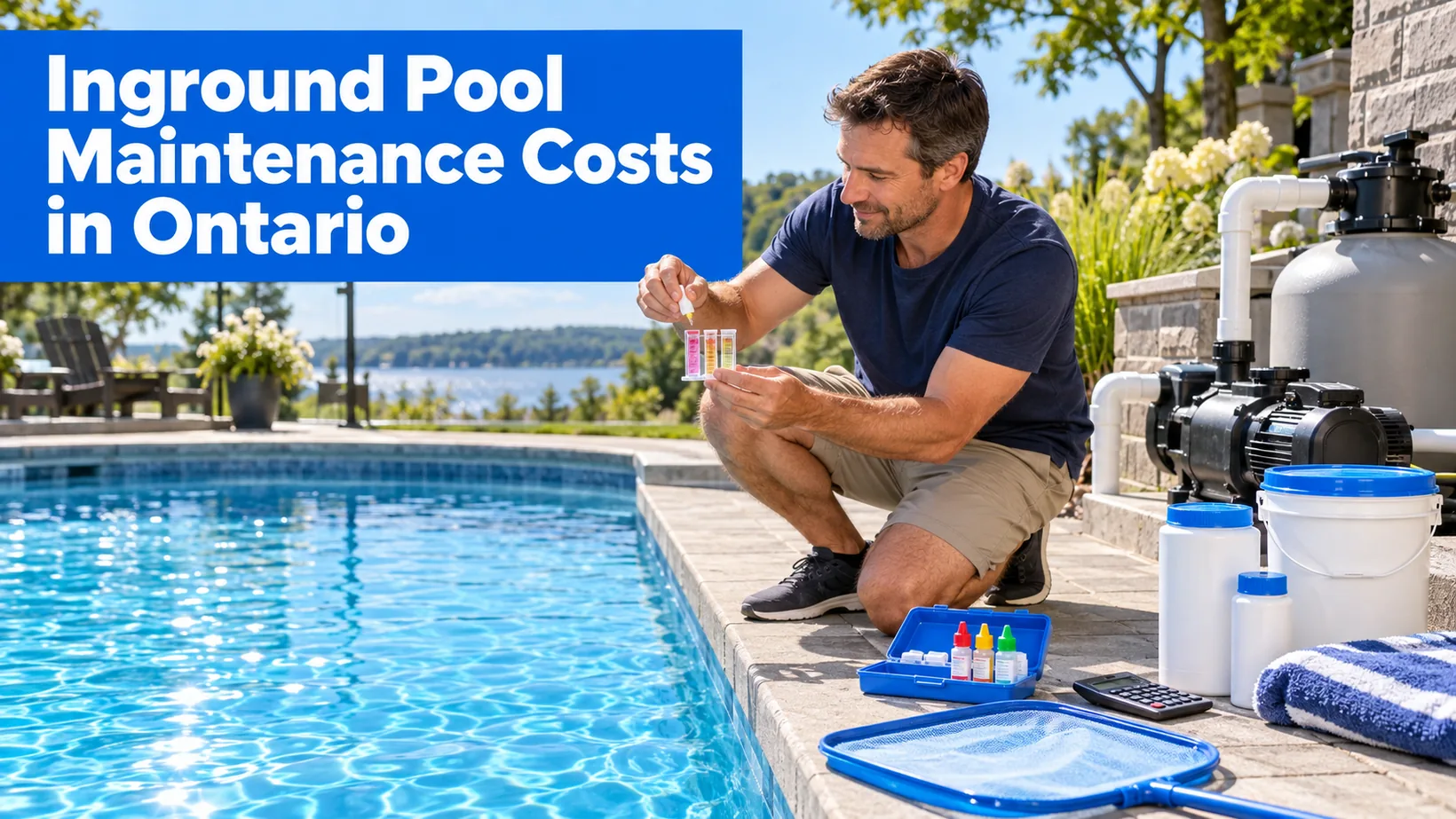
Annual pool maintenance does not have one reliable Ontario average. The useful answer is a property-specific total built from circulation, heating, water, chemicals, cleaning, opening, closing, service and repair reserves.
TL;DR
- Separate routine operating costs from repairs and long-cycle interior renewal.
- Electricity depends on measured equipment draw, runtime and the household’s price plan.
- Heating can exceed basic circulation cost, especially with a long season or high setpoint.
- DIY ownership reduces paid labour but does not remove chemicals, testing or equipment risk.
- Use the calculator below with bills and quotes instead of relying on one generic annual figure.
What belongs in an annual pool budget?
Build the budget with eight accounts:
- Circulation and sanitation electricity.
- Pool heating energy.
- Water for topping up, cleaning and refill events.
- Testing and treatment products.
- Cleaning tools or recurring service.
- Spring opening and fall closing.
- Routine parts and minor repairs.
- A reserve for major equipment and pool-system renewals.
Keep capital events separate. A vinyl liner replacement, concrete finish renewal or major deck repair should appear in a multi-year reserve, not be hidden inside a typical maintenance year.
Calculate electricity from equipment, not pool size alone
Electricity use is measured in kilowatt-hours:
Annual kWh = average input kW × operating hours per day × operating days
Then apply the relevant electricity price:
Electricity-line cost = annual kWh × price per kWh
Ontario households can use Time-of-Use, Tiered or Ultra-Low Overnight pricing. The Ontario Energy Board’s November 2025 rate update set the electricity-line TOU prices at 9.8 cents off-peak, 15.7 cents mid-peak and 20.3 cents on-peak. ULO ranged from 3.9 cents overnight to 39.1 cents during its weekday peak.
Those figures apply to the Electricity line, not the entire bill. Delivery, regulatory charges, tax, rebates and local utility treatment affect the household result. Confirm the current plan and marginal bill effect before using the rates.
Illustrative circulation calculation
Assume a pump averages 0.45 kW for 10 hours per day over 150 days:
0.45 × 10 × 150 = 675 kWh
If every unit fell in a 9.8-cent off-peak period, the electricity-line component would be:
675 × $0.098 = $66.15
This is arithmetic, not a typical pump promise. A real variable-speed program changes draw across several speeds, and the full bill cost is higher than the energy-line calculation alone. Use measured wattage, the equipment display or a qualified technician’s documented estimate.
Heating needs its own calculation
Heating demand depends on water surface area, desired temperature, air temperature, wind, humidity, sun, season length, cover use and heater efficiency. Pool material alone does not determine it.
Record heater type, rated input, measured runtime and energy price. For an electric heater, calculate kWh from input power and hours. For gas, use the billed gas unit and the appliance’s actual consumption basis.
Do not estimate heating from the pump nameplate. Circulation electricity and heat energy are separate accounts even when an integrated control runs both.
A cover can reduce heat and evaporation loss when it is used correctly and suits the pool. The budget should include cover operation, maintenance and eventual replacement rather than treating savings as free.
Add water using local consumption rates
Water use includes evaporation replacement, splash-out, cleaning, backwashing where applicable, leak loss and major refill events. A covered pool with stable plumbing can use far less than an uncovered pool with a leak.
Peel Region’s 2026 water-rate page sets rates from April 1, 2026 and explains that residential wastewater charges are generally applied to 85 percent of metered water use for connected properties. Service-delivery charges are separate.
The current low-volume residential water consumption rate is $1.1308 per cubic metre. A 20-cubic-metre incremental use would therefore add $22.62 to the water-consumption line before wastewater treatment, fixed charges and any other bill effects.
Track the meter before and after a known fill event if practical. Repeated unexplained additions should prompt a leak investigation rather than being normalized as maintenance.
Chemicals and testing are system-dependent
Every pool needs reliable water testing and safe treatment. Health Canada’s residential pool chemical guidance advises a daily sanitizer check alongside three balance measurements: calcium hardness, alkalinity and pH.
Chemical cost varies with pool volume, source water, sanitizer system, sunlight, cover use, bather load, contamination and accuracy of dosing. A salt chlorine generator still requires testing, salt and balancing products, and the cell eventually needs service or replacement.
Build the chemical line from actual purchase records. Separate routine sanitizer from corrective products so an abnormal season remains visible. Include test-kit reagents and replacement probes or sensors where used.
Avoid buying a season’s products from a generic list before testing. Product label, selected equipment and verified water results should determine treatment.
Filter care changes both labour and water use
Cartridge, sand and diatomaceous-earth systems have different cleaning materials, water-discharge effects and replacement parts. Follow the exact filter manual and record pressure when the system is clean so service decisions use a known baseline.
Backwashing adds water and may affect wastewater or discharge planning. Cartridge cleaning uses owner time and eventually replacement elements. Add those quantities to the correct accounts instead of hiding them inside “chemicals.”
An unexplained pressure or flow change deserves diagnosis. Extending runtime cannot correct a blocked line, failing pump, dirty filter or inaccurate gauge, and it can increase electricity without restoring the intended circulation.
Opening and closing costs vary by scope
An opening may include cover removal, equipment assembly, water-level adjustment, system start, cleaning, chemistry and inspection. A closing may include chemistry, lowering water where specified, blowing and protecting lines, equipment winterization and cover installation.
Quotes are not comparable until the same tasks are included. Ask whether water, chemicals, cover cleaning, storage, heater work, salt-cell service and return visits are part of the amount.
DIY opening or closing saves labour only when the owner has the equipment, knowledge and time to perform each step safely. A missed line, plug or drainage condition can create repair cost far above the service fee.
Compare DIY, hybrid and full-service ownership
DIY routine care
The owner tests, treats, cleans and records the pool, while licensed or specialized work remains with appropriate trades. This minimizes recurring labour but requires consistent time and competence.
Hybrid care
The owner handles routine tests and cleaning, then hires for opening, closing, equipment or periodic professional checks. This can preserve control while reducing high-consequence seasonal tasks.
Full recurring service
A service company performs scheduled water care and cleaning, with opening and closing added by scope. This raises labour cost but can fit households that cannot maintain a reliable routine.
No model transfers all responsibility automatically. The contract should define visit frequency, tests, products, reporting, missed conditions and who authorizes repairs.
Use this editable annual cost calculator
Enter household-specific values. Do not double-count tax or services already included in another row.
| Account | Quantity | Unit rate | Annual cost |
|---|---|---|---|
| Circulation electricity | ____ kWh | $____/kWh | $____ |
| Sanitation controls or cell electricity | ____ kWh | $____/kWh | $____ |
| Heating electricity or gas | ____ units | $____/unit | $____ |
| Incremental water | ____ m³ | $____/m³ | $____ |
| Wastewater effect | ____ | ____ | $____ |
| Test supplies | ____ | ____ | $____ |
| Sanitizer and balancing products | ____ | ____ | $____ |
| Cleaning tools or recurring service | ____ | ____ | $____ |
| Spring opening | 1 | $____ | $____ |
| Fall closing | 1 | $____ | $____ |
| Routine parts and callouts | ____ | ____ | $____ |
| Tax and non-duplicated bill charges | ____ | ____ | $____ |
| Annual operating total | $____ |
Add a separate annual reserve below the operating total. Divide each expected long-cycle event by the remaining planning years, but keep the calculation clearly labelled rather than presenting it as a guaranteed lifespan.
Build reserves by pool system
Vinyl liner
Reserve for future liner replacement plus possible wall, floor, track and fitting work. Do not divide one generic liner price by one generic lifespan. Use the installed product, current condition and a property-specific replacement quote.
Fiberglass
Follow the shell and finish documentation. Keep a reserve for product-specific surface repair, fittings and equipment rather than assuming the shell removes every renewal event.
Concrete
Plan for finish inspection and eventual renewal based on the selected interior, chemistry, use and environment. Startup and ongoing chemistry influence surface performance.
All three systems share pumps, heaters, filters, automation, covers, lights and plumbing components. Record installation dates, models and warranty terms so the reserve follows actual equipment.
Three ownership scenarios to model
These scenarios define inputs rather than claim market averages.
Scenario A: restrained DIY season
Use measured pump energy, no regular heating, owner-performed testing and cleaning, professional closing and a modest routine-parts reserve. This scenario is sensitive to owner time and dosing accuracy.
Scenario B: hybrid heated pool
Add heating energy, professional opening and closing, owner routine care, periodic technician review and a larger equipment reserve. Cover use and temperature policy become major variables.
Scenario C: full-service extended season
Include scheduled cleaning and water care, longer pump and heater operation, opening, closing, cover service and higher repair capacity. The contract must distinguish included chemicals and extra visits.
Complete all three columns with the same electricity and water assumptions. The difference then reflects service level and operating choices rather than inconsistent accounting.
Cost-control actions that do not weaken care
- Match pump speed and runtime to verified circulation and treatment needs.
- Shift suitable electrical use to lower-priced periods without compromising sanitation or equipment instructions.
- Use a compatible cover consistently to reduce evaporation and heat loss.
- Repair leaks instead of funding repeated water and heat replacement.
- Test before dosing to avoid unnecessary product and chemistry correction.
- Keep baskets, filters and flow paths maintained under their manuals.
- Set a deliberate heating temperature and season policy.
- Compare service quotes using the same visit frequency and task list.
The PHTA consumer budgeting framework treats maintenance as part of pool ownership, not an afterthought to construction. Safe savings come from measured operation and clear scope, not skipped testing or winterization.
Mayascapes Pools can be assessed on whether its equipment proposal includes expected runtime, commissioning settings and an ownership schedule for the selected pool system. Ask for model numbers, energy inputs, maintenance tasks and renewal items before using any annual estimate.
Turn one season into a better forecast
Record monthly pump and heater energy, water additions, chemical purchases, service visits and repairs. Note opening and closing dates, temperature settings, cover use and unusual weather or bather events.
At season end, separate normal operation from one-time corrections. Update the next budget with actual quantities and current rates. A household with one complete season of records has a better estimate than any province-wide average.
Pool maintenance cost questions
What is included in pool maintenance cost?
Include energy, water, testing, chemicals, cleaning, opening, closing, routine service and repair reserves. Track major liner, finish and equipment renewals separately.
Are saltwater pools free to sanitize?
No. They require a generator, salt, testing and balancing products, electricity, cleaning and eventual cell service or replacement.
Does heating always cost more than circulation?
It can, but the result depends on heater type, temperature, weather, cover use and season length. Measure both accounts separately.
How can I compare service plans?
Normalize visit frequency, tests, chemicals, cleaning tasks, seasonal services, reporting, exclusions, repair authorization, tax and return visits before comparing price.