
Pool Shapes for Ontario Backyards: A Practical 2026 Guide
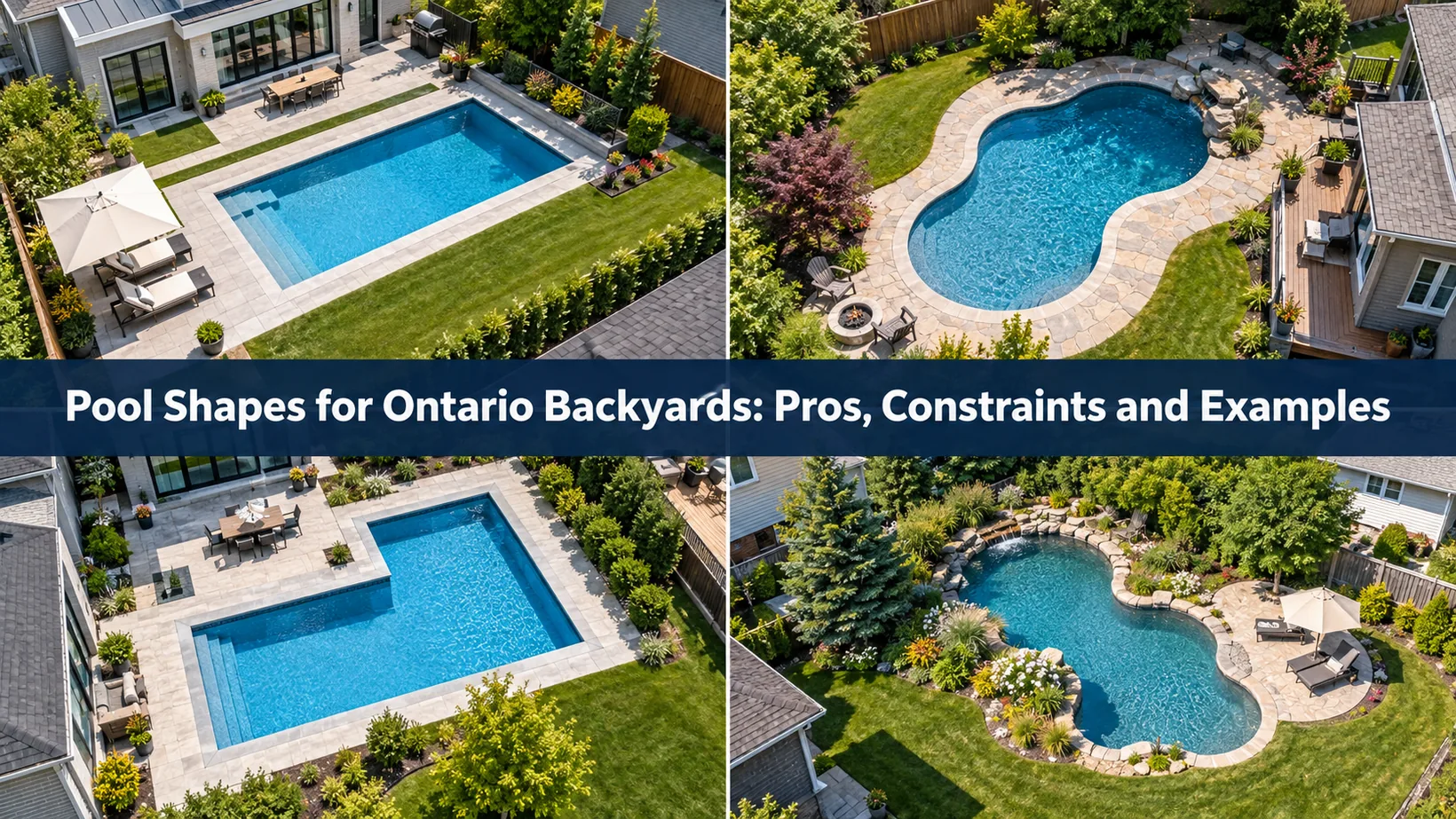
A pool shape should organize the entire backyard, not merely fill the largest open patch. The right outline protects the intended water activity, usable deck, construction access, equipment location, drainage and safe movement around the pool.
TL;DR
- Rectangles use space efficiently and usually simplify covers, exercise lanes and furniture alignment.
- Freeform and kidney pools can soften a landscape, but curved edges need careful deck planning.
- L-shaped pools can separate activities when the lot and construction system support the extra geometry.
- Plunge pools preserve more dry space and work best when cooling or lounging matters more than laps.
- Test two shortlisted shapes on the same scaled site plan before selecting either.
Compare five common pool shapes
| Shape | Strongest use | Main planning advantage | Main constraint |
|---|---|---|---|
| Rectangle | Laps, games, automatic-cover planning | Efficient geometry and clear furniture lines | Can feel dominant on a very narrow or angled lot |
| Freeform | Lounging, landscape-led yards | Curves can respond to planting and irregular edges | Cover, coping and deck details may be more complex |
| Kidney | Social use and soft landscape composition | Defined inward curve can create a deck or planting node | Narrow middle can reduce clear play width |
| L-shape | Two activity zones | Legs can separate exercise from steps or play | Requires enough lot width and precise circulation planning |
| Plunge or compact rectangle | Cooling, therapy, courtyard use | Preserves dry-yard functions | Limited swimming length and group capacity |
This table is a shortlist, not a verdict. Draw the pool’s inside water line, coping, deck and surrounding uses before comparing how each shape performs.
Why rectangles use space efficiently
A rectangle converts most of its envelope into predictable water area. Straight edges make it easier to establish a swimming lane, divide shallow and deeper zones, align a cover and place furniture parallel to the pool.
The shape also suits many architectural styles. A formal rectangle can feel contemporary with large-format paving or traditional with masonry and planting. Its visual character comes from proportion and materials rather than curves alone.
Rectangles still require restraint. A long pool can consume the only practical route between the house and garden. Wide steps, benches or a spa may interrupt the lane that justified the shape. Show those elements inside the water dimensions instead of treating them as invisible extras.
Check the view from primary indoor rooms as well. A pool can fit mathematically while placing equipment, a raised wall or the least attractive edge in the household’s most-used sightline.
When a freeform pool fits better
Freeform geometry can respond to an angled property, mature planting, a change in grade or a landscape-led design. Curves can create distinct seating, planting and viewing areas without making every outdoor element follow one axis.
The benefit disappears when curves are added without a spatial reason. Small radii can create awkward coping cuts, narrow deck pockets or water areas that are difficult to use. Each bend should serve circulation, a feature, a view or a site constraint.
Concrete provides the broadest freedom for unique geometry. Vinyl can support many planned freeform designs. Fiberglass is limited to available moulds. An industry comparison of construction systems identifies concrete as highly customizable and fiberglass as a manufactured shell, making shape inseparable from material.
What a kidney shape does differently
A kidney pool is a specific freeform layout with an inward curve. That indentation can form a natural location for planting, a small deck node or a visual transition between two yard zones.
The centre pinch also reduces usable width. For water games, exercise or a large group, compare the narrowest clear dimension rather than the widest point. A shape can appear generous on a brochure while offering less uninterrupted water than a smaller rectangle.
Kidney pools often work best when landscape composition and casual use matter more than a straight swimming path. Keep the curves broad enough to support practical coping, cleaning and cover decisions.
Does an L-shaped pool solve two activities?
An L-shape can give one leg to swimming and another to steps, play or shallow social use. The separation is legible and can reduce conflicts between activities.
The design requires more yard width, more perimeter and a clear plan for the inside corner. Furniture, supervision and travel routes must work around both legs. The shape may also complicate a cover or increase custom detail compared with a rectangle.
For a compact lot, a smaller rectangle with a well-designed shallow zone may perform better than a compressed L. Choose the L only when both legs retain useful dimensions after setbacks, coping and entries are drawn.
When a plunge pool is enough
A plunge pool prioritizes cooling, soaking, social use or a compact water feature. It can preserve room for dining, lawn, planting or an outdoor kitchen where a conventional pool would consume the yard.
Small does not mean simple by default. Equipment, heating, sanitation, enclosure, drainage and access still need design. Benches and steps take a larger percentage of the water area, so show their clear dimensions.
A plunge pool suits a household that accepts limited swimming length. It is a poor compromise if the primary goal is regular lap exercise or large-group play.
Shape must follow the buildable zone
Use a current survey as the base. Outline the building footprint and legal boundaries, then map registered easements, protected vegetation, elevation changes and existing drainage. Add the pool controls, equipment zone, enclosure, entry gates, construction route and practical deck.
Mississauga’s current municipal installation instructions illustrate 1.5 metres of separation between the water-side pool wall and each property boundary. The scaled drawing must also document site elevations, runoff direction, paved areas, access, vegetation and enclosure.
Property-specific zoning may add restrictions. Under Mississauga’s residential location rules, external equipment may not occupy the front yard and begins with 0.61 m of lot-line separation.
Do not bend a pool around an easement or setback simply because a curved drawing can fit. Confirm the legal and practical envelope first.
How shape affects deck and circulation
Straight edges produce predictable furniture zones. Curves can create attractive pockets, but a pocket is useful only if it holds the intended chair, table or walking route without obstructing another function.
Use a scaled furniture test:
- Draw the gate-to-house and gate-to-equipment routes.
- Add loungers, dining chairs and their pulled-out positions.
- Mark supervision sightlines and entry points.
- Reserve cover operation and storage space.
- Preserve drainage and a maintainable planting edge.
Measure the narrowest route after furniture is placed. A plan with abundant total deck area can still contain one unusable bottleneck.
Which shapes work with each pool system?
Fiberglass
Choose from actual manufacturer models. Compare outside shell dimensions, inside water dimensions, built-in ledges and the delivery route. A model that fits the final opening may still be impossible to lift into the yard.
Vinyl liner
Vinyl supports rectangles and many planned custom shapes. The liner must be accurately fabricated for the completed structure, steps, floor and fittings. Extra corners or integrated features require exact documentation.
Concrete
Concrete provides the greatest custom-shape freedom. That freedom can respond to architecture, grade and integrated features, but more perimeter and detail can increase forming, steel, finish, coping and cover complexity.
Shape does not set price alone. Size, depth, perimeter, access, structure, interior, equipment, deck and landscape scope create the total.
How covers influence the choice
Rectangles normally offer the most direct cover geometry. Some freeform and custom pools can use specialized automatic, safety or winter-cover solutions, but the mechanism, tracks, anchoring and storage need confirmation before the shape is approved.
Ask the cover supplier to mark the operating envelope on the plan. Raised walls, spas, water features, handrails and changing deck levels can affect compatibility. A cover should not be selected from the pool outline alone.
If a simple automatic cover is a non-negotiable, make it a pass-or-fail condition during shape selection. Do not wait until coping is ordered.
Use the shape-by-use matrix
Score each shape from 1, weak fit, to 5, strong fit. Replace these illustrative values after a property review.
| Priority | Rectangle | Freeform | Kidney | L-shape | Plunge |
|---|---|---|---|---|---|
| Straight swimming path | 5 | 2 | 2 | 4 | 1 |
| Compact envelope efficiency | 5 | 3 | 3 | 2 | 5 |
| Distinct activity zones | 3 | 4 | 3 | 5 | 2 |
| Simple cover geometry | 5 | 2 | 2 | 2 | 5 |
| Landscape-led curves | 2 | 5 | 5 | 2 | 2 |
| Preserving dry-yard uses | 3 | 3 | 3 | 2 | 5 |
Weight only the priorities that matter. If lap swimming receives five times the weight of landscape curves, a rectangle may lead. If preserving dining and planting is essential, a plunge pool may outrank every full-size option.
Test two shapes with the same envelope worksheet
Complete this worksheet for both shortlisted shapes:
| Test | Shape A | Shape B |
|---|---|---|
| Clear water length and narrowest width | ____ | ____ |
| Step and bench area inside water | ____ | ____ |
| Largest usable furniture zone | ____ | ____ |
| Narrowest circulation route | ____ | ____ |
| Cover type and operating area | ____ | ____ |
| Equipment and service path | ____ | ____ |
| Construction access method | ____ | ____ |
| Perimeter requiring coping | ____ | ____ |
| Priority activities fully supported | ____ | ____ |
Reject any shape that fails a non-negotiable. Compare the survivors by useful water area and preserved dry-space functions, not visual novelty.
A Mayascapes Pools design should test its concrete, fiberglass and vinyl options on the same scaled base. Ask for the shortlisted shapes to show clear water dimensions, furniture, cover, access, grades and enclosure before selecting one.
Do not let shape create a safety assumption
A curved deep area, long rectangle or large footprint does not automatically make a pool suitable for diving. National backyard-water safety guidance warns that typical residential pools lack sufficient depth for safe diving.
Specify intended activities and obtain the applicable professional design. Use feet-first entry unless the installation was purpose-designed, built and identified for diving under the governing requirements.
Choose the shape that leaves the best backyard
Rectangles excel at efficient water use, lanes and cover planning. Freeform and kidney pools support softer landscape compositions. L-shapes can separate activities, while plunge pools preserve dry space.
The final choice should clear Mississauga’s scaled-plan constraints, fit the selected construction system and protect the household’s highest-priority activity. Use the matrix and envelope worksheet to compare two complete backyard plans rather than two isolated pool outlines.
Pool shape questions
Which pool shape is best for a small backyard?
A rectangle or plunge pool often uses a compact envelope efficiently, but the best fit depends on setbacks, access, deck functions and the intended water activity.
Are rectangular pools always cheaper?
No. Straight geometry can simplify some details, but size, depth, material, access, equipment, coping, deck and features determine the project price.
Can fiberglass pools be freeform?
Yes. Fiberglass manufacturers offer freeform models, but the homeowner must choose an available mould that fits both the yard and delivery route.
Does a freeform pool need more deck?
Not automatically. Curves can create inefficient narrow pockets, so compare usable deck areas and walking routes on a scaled plan rather than total square footage alone.