
Saltwater vs Chlorine Pools in Ontario: Which Works Better in 2026?
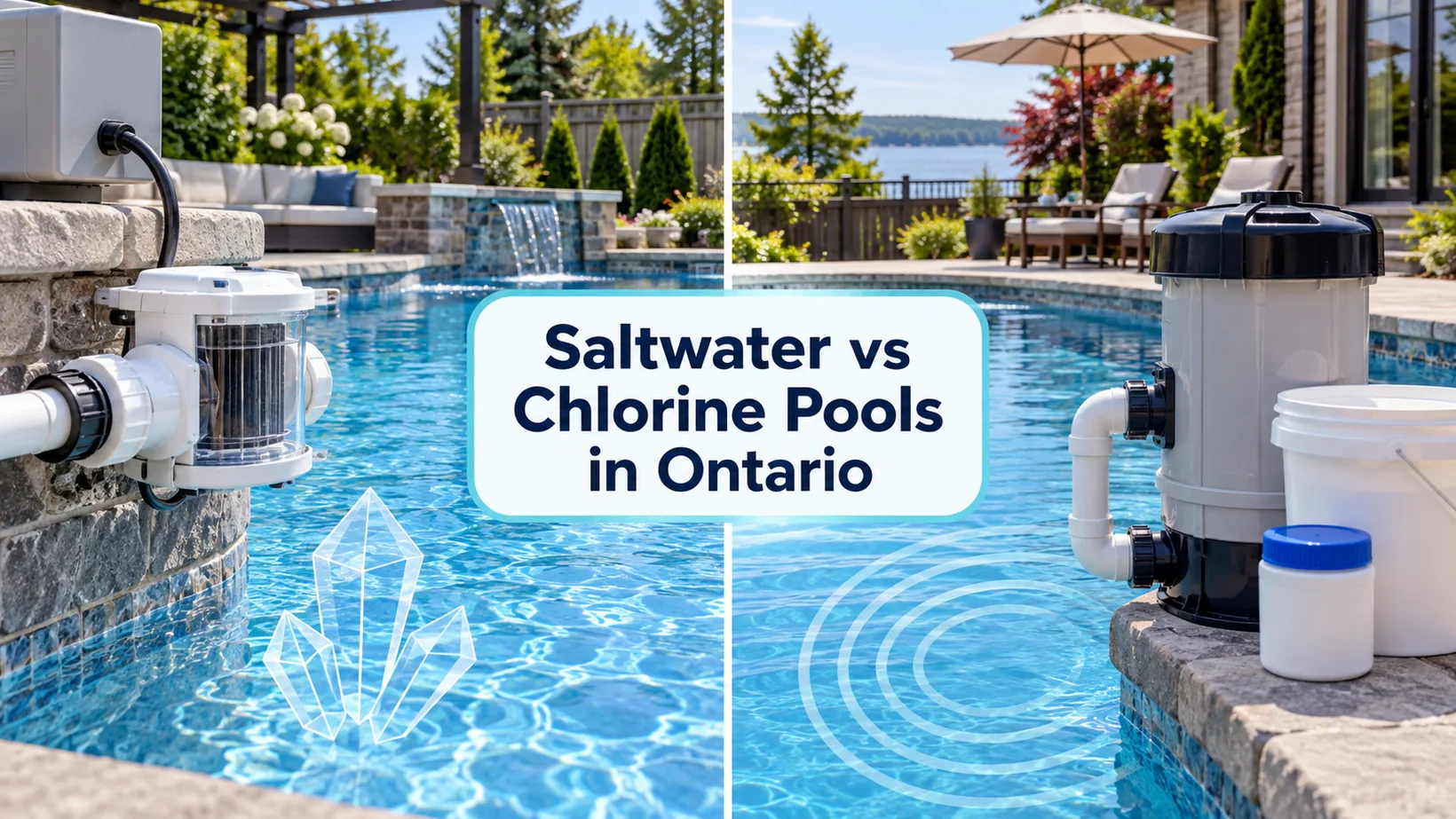
TL;DR
- Saltwater pools still use chlorine; a generator makes it from dissolved salt.
- Both systems require regular testing of sanitizer, pH, alkalinity and other water-balance measures.
- A generator reduces routine manual chlorine dosing but adds a cell, controller and salt-management duties.
- Incorrect chemistry can damage surfaces and equipment in either system.
- Choose by operating routine, material compatibility and service support, not by “chemical-free” marketing.
A saltwater system and a manually chlorinated pool pursue the same outcome: enough active sanitizer to control germs while the water remains balanced for users and equipment. The important difference is how chlorine enters the water and which maintenance tasks follow.
Saltwater pools are chlorine pools
A salt chlorine generator passes low-voltage current through salted pool water. Electrolysis produces chlorine, which forms the same active sanitizing compound used in a conventionally chlorinated pool.
The CDC’s Model Aquatic Health Code annex describes saline chlorination as on-site chlorine generation. The cell does not remove the need for sanitizer testing or corrective treatment.
“Traditional chlorine” usually means the owner or service company adds a registered chlorinating product directly. That product may be liquid, granular or tablet-based, subject to its label and the pool’s equipment plan.
The useful comparison is therefore generator-fed chlorine versus manually added chlorine, not chlorine versus no chlorine.
At-a-glance comparison
| Decision factor | Salt chlorine generator | Manually chlorinated pool |
|---|---|---|
| Chlorine source | Produced from dissolved salt through a cell | Added as a chlorine product |
| Routine dosing | Generator output adjusted to demand | Product type and dose adjusted to demand |
| Testing | Sanitizer and water balance still tested | Sanitizer and water balance tested |
| Added equipment | Cell, power centre or controller, sensors where fitted | Feeder or dosing equipment may be used |
| Main added duty | Inspecting, cleaning and eventually replacing the cell | Buying, storing and applying chlorine safely |
| Material concern | Salt concentration and splash exposure need compatibility checks | Concentrated product handling and local chemical exposure need controls |
| Winter | Generator is shut down and winterized according to its manual | Dosing stops when the pool is properly closed, with chemistry set for winterization |
Neither column is maintenance-free. The better system is the routine the household can execute consistently.
What water testing remains necessary?
Health Canada advises residential pool owners to test sanitizer, pH, total alkalinity and calcium hardness daily. Its pool and spa chemical guidance gives a residential free available chlorine range of 1 to 3 parts per million, while product labels and equipment instructions must also be followed.
The CDC’s home-pool guidance recommends routine free-chlorine and pH testing and explains that sunlight, swimmer waste and dirt reduce available chlorine. It gives a pH range of 7.0 to 7.8 for balancing sanitation, comfort and pipe protection.
A salt cell’s display is not a complete water test. It may report salt or output while free chlorine, pH or other balance measures still require a reliable kit. Manual pools need the same discipline.
Does saltwater feel different?
Many swimmers describe saltwater pools as comfortable or less noticeably chlorinated. That experience varies with the water balance, sanitizer byproducts, salt concentration and individual sensitivity.
Do not promise that a saltwater pool eliminates odour, irritation or “chemicals.” Poorly balanced water can be uncomfortable under either system. Proper sanitizer and pH control matter more than the label attached to the equipment.
Ask to swim in a maintained example if water feel is a deciding factor. Treat personal perception as a preference, not a performance specification.
What equipment does a salt system add?
A residential salt system normally adds an electrolytic cell and controls. The generator must be sized for the pool volume, operating season and chlorine demand. Output changes with water temperature, pump runtime, sunlight and swimmer load.
Cells accumulate scale and wear with use. The CDC annex notes that cell life depends partly on operating hours, pH and calcium content, and that deposits can require cleaning. The selected manufacturer’s cleaning method controls because unnecessary acid exposure can shorten cell life.
Manual chlorination may use simple direct dosing or a compatible feeder. It avoids a salt cell, but the owner must manage product supply, safe storage, accurate application and dosing frequency.
Both systems depend on circulation. A generator produces chlorine only while water flows and the unit is operating under acceptable conditions.
Keep an operating record for either system
Record free chlorine, pH, water temperature, generator output or manual dose, pump runtime and unusual swimmer or weather events. A short log helps distinguish rising demand from failed equipment or an inaccurate test.
For saltwater, add independent salt-test results, cell inspection dates and cleaning actions. For manual chlorine, add product type, concentration, quantity and remaining inventory. Never transfer a dose between products merely because both contain chlorine.
The record should identify who can change controller output or add products. A service visit and an owner adjustment on the same day can otherwise create an unnecessary correction.
Corrosion is a compatibility question
Salt does not guarantee corrosion, and a non-salt pool is not immune to it. Corrosion risk reflects material, concentration, water balance, electrical conditions, splash zones, evaporation, drainage and maintenance.
An iChlor manufacturer manual provides one product-specific example. The installation and operating guide recommends 3,600 ppm salt for that unit and warns that concentrations above 4,500 ppm may damage pool equipment and surrounding surfaces. Those numbers apply to that model, not every generator.
Before choosing saltwater, inventory coping, fasteners, ladders, rails, covers, heaters, heat exchangers, stone, deck furniture and nearby landscape features. Obtain written compatibility and bonding requirements from the relevant manufacturers and trades.
Direct splash and evaporation zones deserve attention. Rinse deposits where the specified maintenance plan calls for it, preserve drainage and avoid directing salty water onto sensitive materials or plants.
Costs belong in different accounts
A salt system adds equipment purchase, installation and eventual cell replacement. It also requires salt, test supplies and balancing chemicals. Its value is mainly a different dosing routine, not the absence of chemical or service expense.
Manual chlorination avoids the generator and cell-renewal account. Its ownership plan includes ongoing chlorine purchases, storage and more direct dosing labour. An automatic feeder may introduce its own equipment and maintenance.
Compare five cost lines over a chosen period:
- Initial equipment and installation.
- Annual sanitizer and balancing products.
- Testing supplies and professional service.
- Equipment cleaning, repair and renewal.
- Material-protection or remediation work.
Use current local quotes and the actual pool volume. Generic annual dollar claims often hide season length, heating, swimmer load and whether service labour is included.
Use this Ontario maintenance calendar
The calendar is equipment-neutral. Replace each task with the selected manufacturer’s frequency and the technician’s commissioning plan.
| Interval or event | Salt generator pool | Manually chlorinated pool |
|---|---|---|
| Before opening | Inspect cell, controls, bonding and salt plan | Inspect storage, feeder and dosing equipment |
| At opening | Balance water before enabling normal production | Balance water before establishing normal dose |
| Daily during use | Check sanitizer and core water-balance measures | Check sanitizer and core water-balance measures |
| Weekly planning check | Compare output, pump runtime and demand | Review dose pattern, inventory and demand |
| After heavy use or contamination | Test promptly and follow corrective protocol | Test promptly and follow corrective protocol |
| After major rain or water addition | Recheck chemistry and salt where relevant | Recheck chemistry and dilution effects |
| Cell alert or low production | Confirm flow, water temperature, salt and cell condition | Confirm feeder, product, circulation and test result |
| Closing | Follow generator shutdown and winterization manual | Follow product, equipment and winterization plan |
| Off-season review | Record cell hours, condition and expected renewal | Review unused product storage and next-season supply |
The task calendar is the same foundation for both systems: test first, identify demand, adjust safely and record unusual changes.
Match sanitation to pool materials
New plaster can have a controlled startup period before salt is introduced. The cited iChlor manual requires waiting at least one month after construction and defers to the surface manufacturer. It separately directs owners of new vinyl pools to obtain manufacturer guidance.
That example shows why the complete system matters. Pool surface, liner, metal components, heater and generator manuals must agree. A general installer preference cannot override the selected product’s requirements.
For an existing pool conversion, inspect components and surfaces before adding the generator. Confirm generator capacity, electrical and bonding work, flow conditions and where drained or backwashed water will go.
Who should choose saltwater?
Saltwater can suit an owner who wants automatic chlorine generation, accepts equipment monitoring and has compatible surrounding materials. It is especially attractive when a reliable service provider can commission the system and teach the owner how output relates to actual test results.
It may be a poor fit when sensitive materials cannot be protected, the owner expects no testing, or replacement-cell planning is unacceptable.
Who should stay with manual chlorine?
Manual chlorination can suit an owner who prefers simpler installed equipment, is comfortable handling registered products and can dose consistently. It may also preserve flexibility where an existing pool contains components with uncertain salt compatibility.
It is a poor fit when product storage is unsafe, dosing will be irregular or the household expects chlorine demand to remain constant through weather and use changes.
When considering Mayascapes Pools, require its recommendation to account for the chosen pool material, heater, metals, coping, drainage and service routine. Ask for the exact generator or dosing method, commissioning targets, winter procedure and renewal items in writing.
Use a pass-or-fail compatibility checklist
Do not select either system until every applicable box can be completed:
- Pool volume and peak seasonal demand are known.
- The sanitizer equipment is sized and identified by model.
- Surface and liner startup instructions are available.
- Heater, metals, cover and coping compatibility are confirmed.
- Electrical, bonding and flow requirements are documented.
- Test method, targets and correction authority are assigned.
- Chemical storage and handling are safe.
- Cell cleaning or feeder maintenance is understood.
- Closing and winterization duties are defined.
- A replacement and repair budget exists.
A failed compatibility item outweighs a preference for feel or convenience.
The better system is the one you can maintain
Saltwater produces chlorine through a cell and changes the dosing workflow. Manual chlorination adds sanitizer directly and avoids the cell. Both need routine testing, balanced water, safe handling and compatible equipment.
Choose saltwater when automated production and the installed materials align. Choose manual chlorine when simpler equipment and direct dosing better fit the owner. In either case, use Health Canada’s testing framework, the selected equipment manual and a written Ontario seasonal-care plan.
Saltwater and chlorine pool questions
Is a saltwater pool chlorine-free?
No. The generator converts chloride from dissolved salt into chlorine, which sanitizes the pool.
Do salt pools need shock treatment?
They may need corrective chlorination after unusual demand or contamination. Follow test results, public-health guidance and the selected equipment and product instructions.
Is saltwater cheaper every year?
Not automatically. Compare generator purchase, salt, cell renewal, chemicals, testing and service with chlorine products, storage, dosing labour and any feeder costs.
Can an existing Ontario pool be converted?
Often, but suitability depends on pool volume, equipment, materials, electrical and bonding conditions, circulation, drainage and manufacturer requirements. Obtain a documented compatibility review first.